Nikortsminda Cathedral
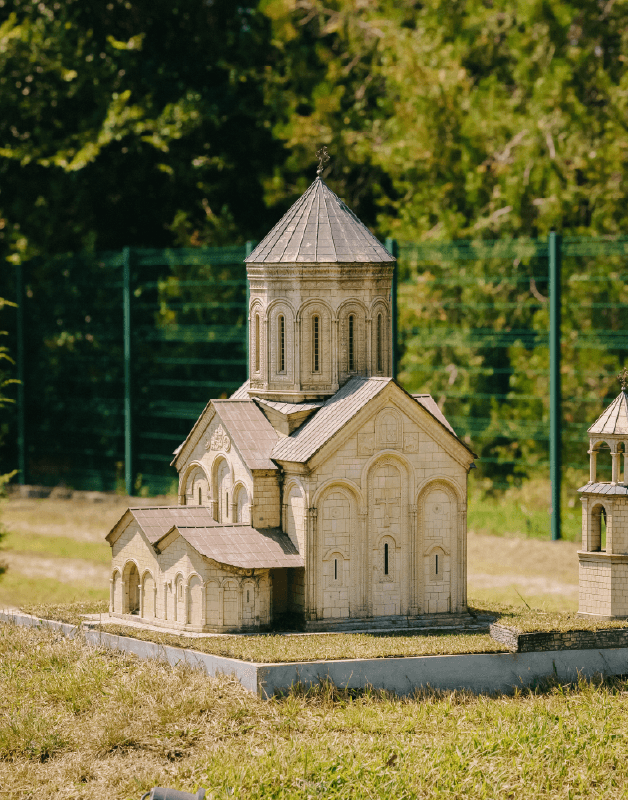
This masterpiece of national architecture is located in the village of Nikortsminda, in the Ambrolauri municipality. It was built between 1010 and 1014. During this period, particular emphasis was placed on decorative facade embellishments. In this regard, the ornamentation of Nikortsminda represents a pinnacle of Georgian monumental stone carving. Remarkably, the monument has undergone very few changes throughout its existence, a rare occurrence. The cathedral’s dome has survived in its original form.
Following the establishment of the Duchy of Racha, the foundation for the construction of the grand Cathedral of St. Nicholas was laid by the order of Bagrat III, the first king of unified feudal Georgia. The cathedral soon became the cultural center of the duchy. From the 11th to the 13th centuries, Nikortsminda served as the family monastery of the Dukes of Racha - the Kakhaberidze dynasty. In the 1280s, King David VI Narin of Western Georgia accused the Kakhaberidze family of treason and had the entire dynasty eliminated. As a result, Nikortsminda lost its patronage and significantly declined in importance. However, in the 1530s, King Bagrat III of Imereti showed care for the site and had the cathedral restored. During the 16th and 17th centuries, Nikortsminda served as the burial place of the local noble family - the Tsulukidzes.
Did you know that…
1. The complex murals inside the cathedral date from the 16th to 17th centuries and feature two distinct layers of painting. Numerous portraits of secular figures are present, accompanied by inscriptions.
2. During rehabilitation work carried out in 2012, previously unknown 16th-century frescoes were discovered beneath plaster in the church’s gateways. These include depictions of the cathedral’s patrons, local feudal lords, and the Archangel Michael. One of the fresco inscriptions mentions the painter of the church, a certain Javakhadze.
