Mtskheta Jvari Monastery
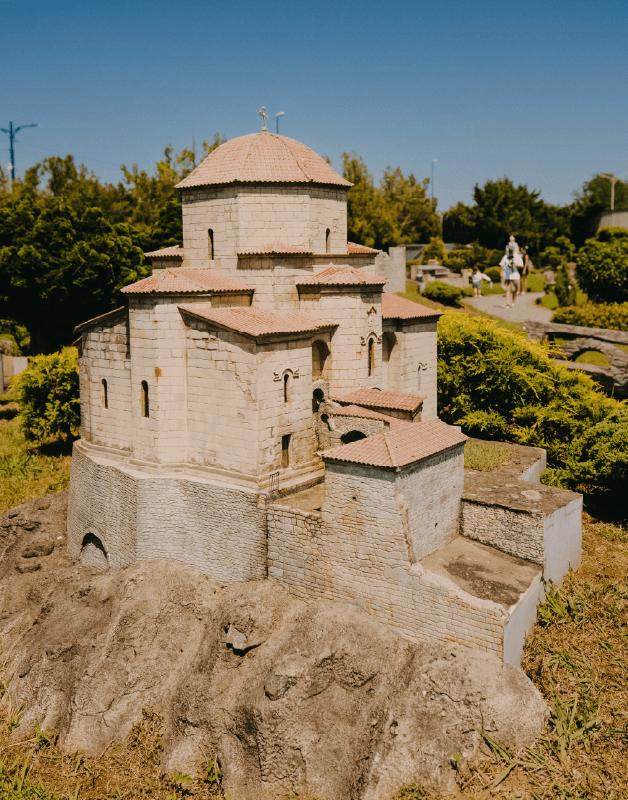
To the east of Mtskheta, perched atop a rocky mountain peak, stands a 6th-century monastery that houses one of the oldest examples of the Georgian Asomtavruli script. The Jvari Monastery of Mtskheta is inscribed on the UNESCO World Heritage List.
The name of the monastery has a historical origin. In the 330s, during the early years of Christianity in Georgia, King Mirian III had a wooden cross erected on this site. In time, not only Georgians but also Christian communities from across the Caucasus came to venerate it. In the second half of the 6th century, Guaram, the ruler of Kartli, built a small monastery to the north of the cross. Later, in the late 6th and early 7th centuries, his son, Prince Stepanoz I, constructed a larger monastery adjacent to the smaller one, directly over the wooden cross—its base still preserved inside the monastery to this day.
Did you know that...
1. Georgian scholar Giorgi Chubinashvili determined the construction dates of the Small and great monasteries of Jvari through detailed analysis of the monuments themselves. Over the centuries, the Small monastery suffered significant damage, while the Great monastery has been better preserved and has survived in a more complete state.
2. The Jvari Monastery underwent several restorations and conservation works over the years: from 1924 to 1927 (led by Giorgi Chubinashvili and Nikolai Severov); from 1933 to 1939 (again under the direction of Chubinashvili and Severov); from 1963 to 1965 (led by Rusudan Gverdtsiteli).
3. The Jvari monastery is considered the crowning achievement and the most complete embodiment of early Georgian architecture. It laid the foundation for an entire stage of architectural development: in the 7th century, a group of similar monuments emerged that closely resemble the Jvari monastery in terms of layout and overall structure. Naturally, they differ in certain features and details. Among these are the Ateni Sioni Church, Old Shuamta, and Martvili.
4. According to tradition, on the opposite side of Mtskheta, beyond the Aragvi River, there once stood a strange tree atop a high rocky mountain. The tree emitted a miraculous fragrance, and people called it a wonder-working tree. It was believed that if a wounded animal or bird ate its leaves, it would be instantly healed. With the blessing of the bishop and accompanied by the people, King Mirian’s son, Rev, had the tree cut down and brought to Mtskheta, where it was erected on the southern side of what is now Svetitskhoveli. From this sacred tree, three wooden crosses were made: one was erected on the site of the present-day Jvari Monastery — where the stone base of the cross still stands; the second was placed on Mount Tkhoti, where King Mirian was temporarily blinded; and the third was set up in Ujarma.
5. One of the oldest surviving epigraphic examples of the Georgian Asomtavruli script is carved on the Jvari Monastery in Mtskheta. Inscriptions can be found on the reliefs of the eastern and southern façades, on the base of the cross erected in the center of the monastery (a surviving fragment of this base, with part of the inscription, is now preserved at the Georgian National Museum), above the entrance to the room in the monastery’s southwest corner, and on individual stone slabs of the walls. All the inscriptions are contemporaneous and are dated to the late 6th–early 7th centuries, based on references to historical figures, specifically to Stepanoz's tenure as Prince of Kartli.
