Ikorta Church
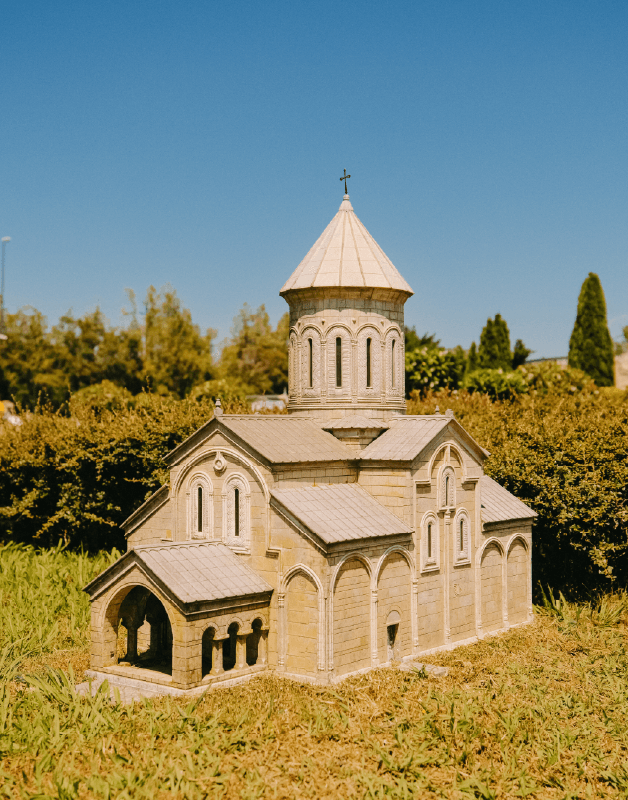
A 12th-century domed church nestled in the valleys of Inner Kartli, holding a special place in the history of Georgian architecture. It is distinguished by rich carvings and high craftsmanship. The church belongs to the group of domed churches where the canonical form of the Georgian domed church was finally developed.
The monument dates back to the 12th century. In the Middle Ages, there was a monastery here, although no records about its founding survive. Historical sources show that from later centuries, the monastery and this area belonged to the Eristavis of Ksani, who turned the place into a fortress. The church was surrounded by a defensive wall, with rectangular towers standing at the eastern corners. To the west, an elevated area housed a rather complex citadel. The defensive wall has not survived to the present day; only ruins of the southeastern tower remain at a height of 4-5 meters. The citadel is heavily damaged. Inscriptions remain on the church facade, where the names of the ktitors and the construction date — 1172 — can be read.
Did you know that...
1. The leaders of the 1659 Kakheti uprising — Bidzina Cholokashvili and Elizbar and Shalva Eristavis — are buried in Ikorta Church. They were tortured and killed in Iran, and several years later their remains were secretly transferred to Ikorta.
2. Ikorta Church is located in the region of Lower Kartli, in Gori Municipality, on the outskirts of the village of Ikorta (occupied by Russia since 2008).
3. The territory where Ikorta Church is located has been occupied by Russia since 2008. The closest current view of Ikorta Church is now possible from the village of Kitsani.
