Gremi
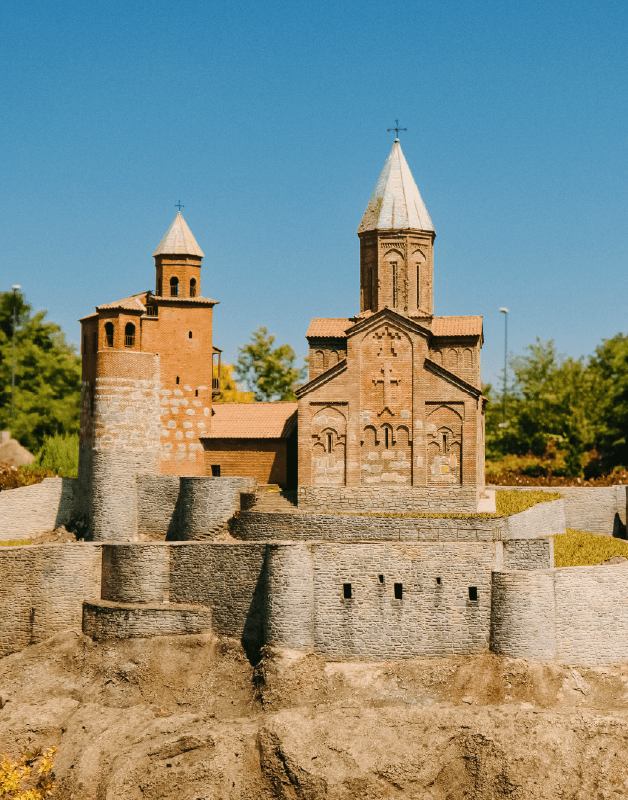
This impressive monument of Georgian architecture was built in 1565 by King Levan of Kakheti. It stands on a high hill south of the modern village of Gremi. The architectural complex includes the domed Church of the Archangels, a three-story royal residence with a bell tower, various utility structures, fortified walls, and a hidden passageway leading to the river.
Gremi’s history as a city began in the 15th century, when King George I of Kakheti (r. 1466–1476) designated it as the royal capital. Gremi remained the political, economic, and cultural centre of Kakheti for nearly two centuries. It was a hub of manuscript production and an important trade point along caravan routes. Archaeological evidence suggests that the area was first inhabited during the Iron Age, with later settlement layers dating from the 13th–14th centuries. It is believed that a small settlement here was transformed into a city in the 15th century. Like much of eastern Georgia, Gremi suffered greatly during the invasions of Shah Abbas I in the 17th century.
Did you know that…
1. Since 1975, the historical complex of Gremi has operated as a museum-reserve.
2. The bell tower of the royal palace houses an ethnographic exhibition featuring artefacts uncovered through archaeological excavations: Bronze Age weapons and jewellery, small animal figurines, iron axes (12th–13th centuries); ceramics, glazed tiles and bricks, drinking water pipes (15th century); and mediaeval weaponry, including a cannon and a bow with arrows (16th century).
3. The museum holds a total of 2,056 objects, while additional artefacts from Gremi are preserved in the Georgian National Museum.
