Former Ministry of Highway Construction
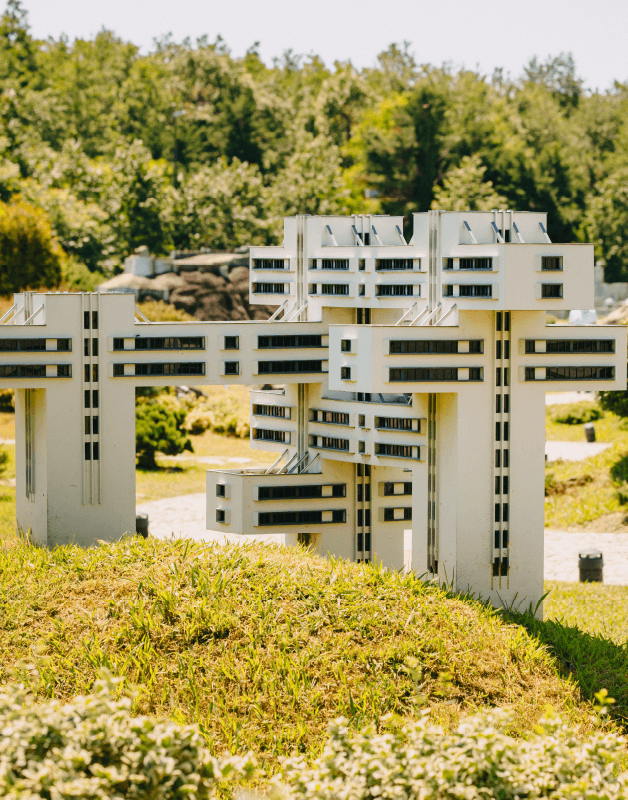
Former Ministry of Highway Construction was constructed in 1975 based on a design by architects Zurab Jalaghania and Giorgi Chakhava. The structure is distinguished by its post-constructivist, modernist style. This monumental building was called by The New York Times “a surprising discovery for the West that shattered many standard clichés about late Soviet architecture".
One of the most original buildings in 1970s Tbilisi had no exact counterpart or precedent at the time. It is distinguished by its bold structural design and geometric form, yet it sits comfortably within the landscape - a quality enhanced over the years by its green, plant-covered facades. In 1977, issue 577 of Domus magazine featured an article about this new architectural landmark in Tbilisi. Recognized as an architectural masterpiece, the building was included in a recent publication by the publisher TASCHEN. The former Ministry of Highway Construction has been featured in numerous books, scholarly works, catalogs, and popular publications.
Did you know that...
1. The former Ministry of Highway Construction is visually striking due to its synthesis of three distinct elements - geometry, formalism, and integration with the landscape. However, its main originality lies not in its visual aesthetics but in its architectural design.
2. Researchers trace the conceptual roots of this 1975 building in Tbilisi back through various periods of urban culture, exploring the influences that may have shaped the architects’ experimental vision. It is difficult to separate this work from the legacy of Soviet architecture, which began in the 1920s and evolved through unique experiments and trends up until the 1970s. In fact, the 1920s represent the period from which the current form and conceptual idea of the Georgian Bank’s headquarters should draw the most inspiration.
